
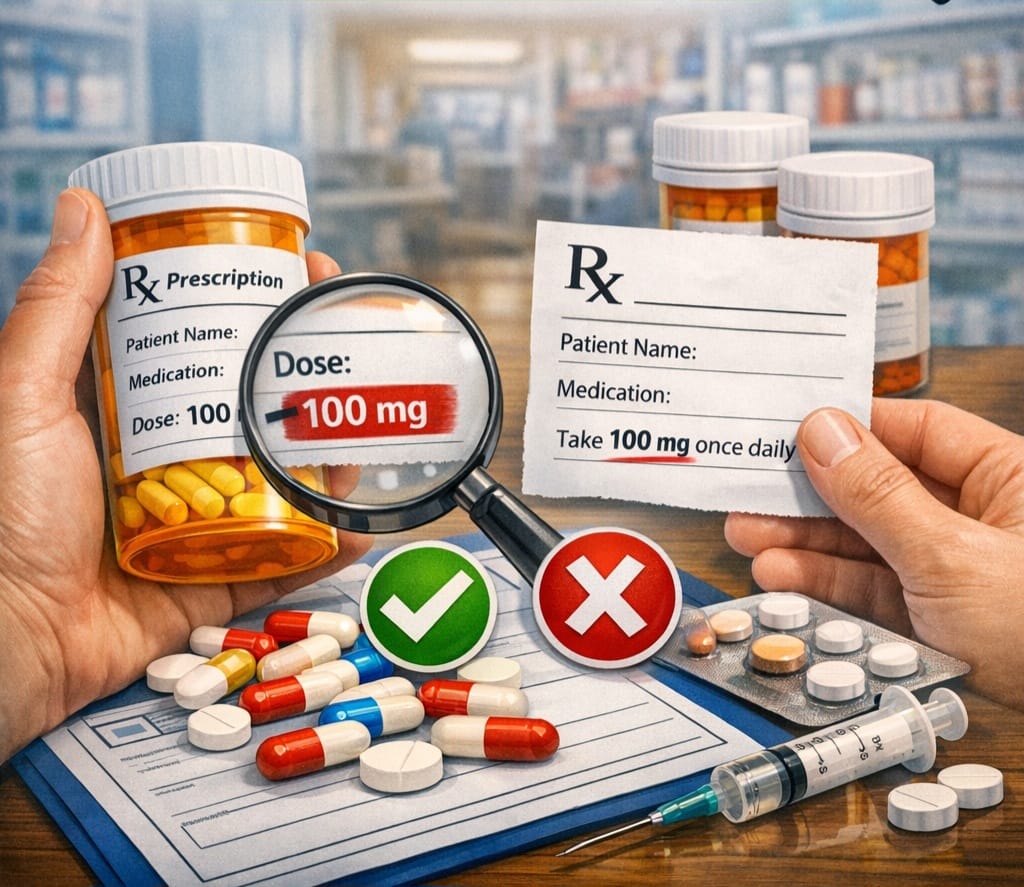
While doctors and pharmacists work hard to ensure medication safety and accuracy, errors can still happen, especially in busy healthcare settings. This is why patients must play an active role and partner with healthcare workers in ensuring their safety. A simple habit like double checking prescriptions and medicine labels can help to prevent harm arising from medication errors. By double checking prescriptions and medications, patients act as an additional and final safety check that can catch errors before taking a medication.
In this blog, we shall discuss why double-checking matters.
1. Medication errors
Mistakes can happen at any stage of the healthcare process from prescribing, dispensing, administration and monitoring of medications. A wrong medication, an incorrect dose, wrong instructions, and even a wrong patient, are common prescription issues in busy healthcare set ups. You should never assume that everything is automatically correct after a visit to your doctor or pharmacist.
2. Your medication history
Double checking your prescription ensures that a new medication is not contraindicated due to allergic reactions or preexisting conditions. It also helps you to identify duplication or omission of therapies, and to ensure a new medication does not interact with other medications that you are taking.
3. Instructions are not always obvious
Confirming the correct instructions avoids confusion and helps you to use your medications in the right way. When you understand how to take your medicine, you are empowered to stay on track and ensure your health and safety. If the instructions read “use as directed”, do not be afraid to ask for specific instructions.
4. Medication brands and generics
Changes in medication brands and packaging can be very confusing. A quick check ensures that you have the right drug even if it looks different. In addition, many medication names sound almost similar and can be confusing. For example, Adderall (for ADHD) vs. Inderal (for blood pressure). Checking your prescription ensures that you are taking the right drugs for the right condition.
Things You Must Check Before Leaving the Pharmacy
Whenever you fill your prescription at the pharmacy, always ensure you have confirmed the following:
1. Your Name
In a busy pharmacy, prescription mix-ups can happen among patients, especially those with similar names. You should always take a moment to read the medicine label and confirm that it has your name on it and that it is spelt correctly. This is something that many patients overlook and they end up going home with medications that belong to someone else.
2. The Medication Name
Knowing the name of your medicine by brand and generic names is important so that if a medicine looks different from what you have been using, you can check with your pharmacist. Sometimes, your pharmacist may dispense a different brand or a generic version that looks different but contains the same active ingredient. Changes in branding and packaging by manufacturers are common. Even so, you must still seek clarification from your pharmacist.
3. The Dose
You should always confirm the strength of the medication you are taking e.g. 0.5mg vs 5mg. Taking the wrong dose can result in an underdose where the medication will not be effective or an overdose where the medication could be harmful. In some cases, the difference between a therapeutic dose and a dangerous dose can be a single decimal point e.g. if your medicine label reads 5.0mg but the correct prescribed dose is 0.5mg, the results can be serious.
4. The Instructions
When it comes to medications, following the correct instructions ensures that the medications work effectively. Do not leave the pharmacy without asking about the frequency and duration of treatment as well as any special instructions concerning food and drinks. If the instructions given are different from what you discussed with your doctor, do not hesitate to ask for clarification.
5. The Quantity
If your medication label says 10 tablets but you expected a 30 day supply, verify this with your pharmacist. It could be that the doctor prescribed a shorter course, there is a stock shortage or insurance limits that can only allow a limited quantity of medication to be supplied.
When to Speak to Your Pharmacist
Pharmacists are highly qualified medication experts and work to ensure medications are used safely, effectively and correctly. Always consult with your pharmacist if:
- The medicine looks different.
- The instructions are not clear.
- You were expecting a different medication.
- You are unsure why you are taking the medication.
Final Dose of Clarity
Double checking your prescription helps to prevent medication errors. Before you leave the pharmacy, always ensure that you have checked the medicine label and that you have ensured that everything is correct, because as a patient, you are an important safety layer.
Disclaimer: Health information shared here is for education only. Please speak to your doctor or pharmacist before making decisions about your health or medications.
Enjoyed this post? Get more health insights straight to your inbox!